Post
Sharpie Permanent Markers: The Definitive Guide to America’s Most Versatile Marking Tool
May
Sharpie Permanent Markers: The Definitive Guide to America’s Most Versatile Marking Tool
No product in the stationery world has achieved the cultural ubiquity of Sharpie Permanent Markers. The Sharpie name has become so synonymous with permanent markers that it functions as a generic term — people routinely ask for “a Sharpie” when they mean any permanent marker, just as they ask for “Scotch tape” when they mean any transparent tape. This linguistic displacement is the ultimate measure of brand success, and Sharpie achieved it through decades of reliable performance, continuous innovation, and a product range that has expanded to cover virtually every surface, color, and tip configuration that a marking need could require.
The Chemistry of Permanence
Understanding what makes a Sharpie permanent requires understanding what the word “permanent” means in the context of markers. Sharpie markers use an alcohol-based ink that, once dried, forms a chemical bond with the surface it was applied to that resists water, making marks that cannot be removed by washing with water alone. The ink penetrates surface pores rather than simply sitting on top of the material, which contributes to both its adhesion and its permanence.
The alcohol-based formulation dries extremely quickly — Sharpie marks are typically dry to the touch within seconds of application on most surfaces, minimizing the risk of smearing that slower-drying markers suffer. The volatile alcohol carrier evaporates rapidly after application, carrying the pigment into the substrate and leaving behind a permanently adhered mark. This rapid drying is one of the reasons Sharpies are so effective on non-paper surfaces where water-based markers would bead up and fail to adhere.
Surface Versatility
The Sharpie’s compatibility with an extraordinary range of surfaces is the feature that distinguishes it most clearly from water-based markers. Standard Sharpie markers perform reliably on paper, cardboard, wood, most plastics, metal, glass, ceramics, fabric, rubber, and many other substrates. This surface agnosticism makes the Sharpie genuinely useful in contexts where other markers would fail — marking tools and equipment in workshops, labeling storage containers, signing merchandise, marking cables in technology installations, and countless other industrial and creative applications.
On smooth, non-porous surfaces like glass and polished metal, Sharpie marks are more readily removed with alcohol-based solvents or acetone than on porous substrates where the ink has penetrated. This relative removability on non-porous surfaces is often presented as a limitation but functions as a practical advantage in many contexts — a mark on a whiteboard or glass surface that needs to be temporary can be removed, while marks on wood or fabric are genuinely permanent.
The Tip Range: Fine, Ultra Fine, Chisel, and Beyond
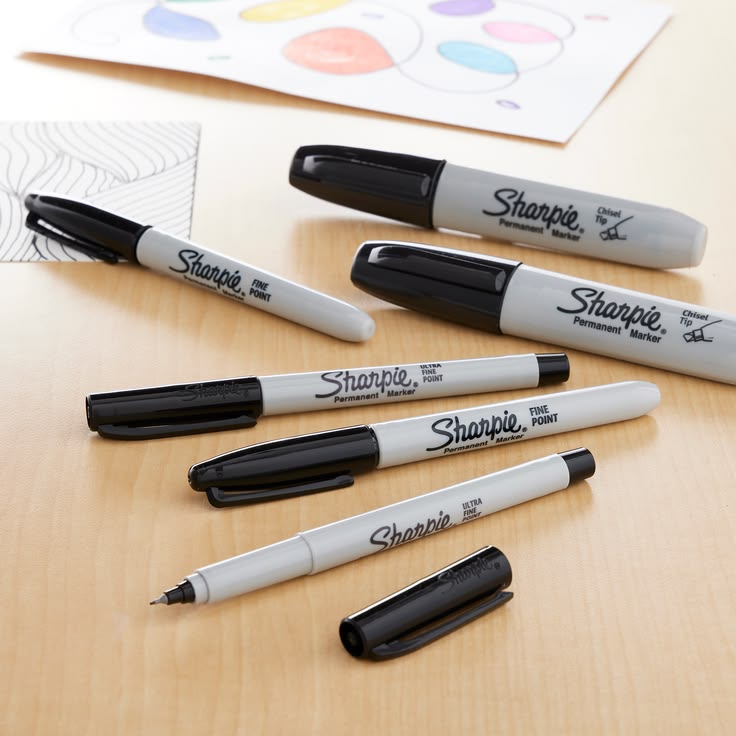
Sharpie’s standard product line encompasses four primary tip configurations. The Fine tip is the classic Sharpie configuration — a bullet-shaped felt tip approximately 1mm wide that produces a consistent, medium-weight line suitable for writing, labeling, and general marking. The Ultra Fine tip narrows the mark to approximately 0.3mm, enabling precise handwriting, detailed labeling, and work in tight spaces where the standard fine tip would be too broad. The Chisel tip combines a broad flat side for thick marks and a narrow edge for fine lines, making it particularly useful for handmade signage, title writing, and applications where both thick blocks and fine details are needed. The Super tip and various other specialized configurations extend the range for specific applications.
Color Range and Organization
While the classic Sharpie is available in over thirty colors, the black Sharpie Fine Point remains the definitive version — the one that has colonized every kitchen drawer, office desk, and tool chest in America. For color applications, Sharpie’s extensive palette enables the organization systems, color-coded labeling, and artistic applications that make the marker range so versatile. The colors maintain consistency across the range and reproduce reasonably well in photographs, which matters for content creators who document their organizational systems or artwork online.
Artistic Applications
Sharpies have found an enthusiastic community among artists and illustrators who exploit the marker’s properties for creative purposes. Sharpie-on-CD artwork achieved a moment of cultural prominence in the 2000s, when artists discovered that the smooth, non-porous surface of compact discs accepted Sharpie ink in ways that created distinctive interference patterns when manipulated with alcohol while wet. More broadly, Sharpies are used for illustration on fabric, wood, rock, and other three-dimensional surfaces that conventional art media cannot address effectively.
Professional and Industrial Uses
In professional and industrial contexts, Sharpies perform functions that no other commonly available marker can. Construction workers mark measurements on lumber and pipe. Warehouse workers label inventory. Healthcare workers mark specimens and equipment. Automotive technicians label parts during disassembly. The combination of fast drying, reliable adhesion across surfaces, and consistent availability makes the Sharpie the default choice in countless professional marking applications.
Scent and Safety Considerations
The alcohol-based ink produces a distinctive solvent odor during use that is the Sharpie’s most recognizable sensory characteristic. The odor dissipates quickly after application as the alcohol evaporates, but in enclosed spaces or during intensive use, ventilation is advisable. Sharpie’s inks comply with safety standards for consumer products, but extended exposure to the fumes in confined spaces is not recommended. For applications involving intensive extended use, the low-odor formulations Sharpie offers for some products provide a more comfortable working experience.
Conclusion
The Sharpie Permanent Marker has earned its cultural dominance through genuine excellence at its core function combined with a versatility that competitors have never fully replicated. From the kitchen to the workshop to the art studio to the industrial facility, the Sharpie performs reliably and remains the definitive answer to the question of what to use when you need a mark to stay. Keep one in every room, every bag, and every tool kit — you will use it more than you expect.
Final Thoughts and Long-Term Value
One of the reasons this product continues to remain popular among students, professionals, hobbyists, and collectors is the balance it offers between affordability, reliability, and everyday usefulness. Many products become successful for a short period because of trends, marketing campaigns, or social media attention, but truly excellent tools continue to be recommended for years because users trust them in practical situations. A dependable writing or office tool becomes part of a person’s daily routine, and over time that familiarity creates a stronger appreciation for the product’s design and consistency.
Another important factor is versatility. Whether the product is being used in schools, offices, creative studios, or at home, it adapts well to different environments and different working styles. People often underestimate how much productivity and comfort can improve when they use tools that are thoughtfully designed. Small details such as grip comfort, balanced weight, smooth performance, refillability, durability, and portability all contribute to a better overall experience. These qualities are especially valuable for people who spend many hours writing, organizing, drawing, planning, or studying.
In addition to functionality, the product also reflects broader trends in modern stationery culture. Over the past decade, interest in premium stationery and high-quality office supplies has increased dramatically around the world. Many consumers now see stationery not only as a practical necessity but also as a form of self-expression and creativity. This shift has encouraged manufacturers to improve aesthetics, expand color selections, refine materials, and introduce features that make everyday tasks more enjoyable. As a result, products like this continue to gain loyal communities of enthusiasts who share recommendations, reviews, and creative uses online.
Durability also plays a major role in long-term value. A product that lasts for years reduces waste and provides better value compared to disposable alternatives that need frequent replacement. Consumers are increasingly paying attention to sustainability, and reusable or refillable stationery products align well with those priorities. High-quality construction means the product can maintain strong performance over extended periods, making it a worthwhile investment for people who value dependable tools.
Ultimately, the enduring success of this product comes from its ability to combine thoughtful engineering, user comfort, visual appeal, and practical reliability into a single experience. It is easy to recommend because it consistently delivers what users expect while also offering small details that improve everyday tasks in meaningful ways. Whether someone is discovering the product for the first time or has been using it for years, it remains one of the strongest options available in its category and continues to set a high standard for competitors across the stationery industry.
