Post
Rhodia Webnotebook A5: French Precision and the Finest Notebook Paper Available
May
Rhodia Webnotebook A5: French Precision and the Finest Notebook Paper Available
In the passionate world of notebook enthusiasts — a community that discusses paper quality, pen compatibility, ruling formats, and binding methods with the same seriousness that audiophiles discuss speaker specifications — the Rhodia Webnotebook occupies a particular position of reverence. Its reputation rests primarily on a single, decisive characteristic: the paper inside it may be the finest available in any commercially produced notebook. For fountain pen users, brush pen calligraphers, and anyone who writes with instruments that reveal paper quality through their performance, the Rhodia Webnotebook A5 is the reference product against which everything else is benchmarked.
The Clairefontaine Connection
Rhodia is a brand under the Clairefontaine family of companies, which has been producing paper products in France since 1858. Clairefontaine operates one of France’s largest and most technically advanced paper mills, producing paper on equipment that has been refined through over 160 years of manufacturing experience. The quality standards maintained at Clairefontaine’s facilities are reflected directly in the paper that goes into Rhodia products — manufacturing decisions are made based on paper performance rather than cost minimization, producing paper that outperforms equivalently priced products from manufacturers who prioritize margin over material quality.
Rhodia Paper: A Technical Profile
The Webnotebook uses Rhodia’s 90 g/m² Clairefontaine paper — the highest paper weight found in any commonly available premium notebook and a measurable 10-20% heavier than the paper used by Leuchtturm1917 and Moleskine respectively. The weight difference has practical implications. Heavier paper provides more resistance to ink bleed-through, more physical body that prevents pages from wrinkling under moisture, and a more substantial writing surface that some writers find more satisfying for the tactile feedback it provides.
The paper’s surface quality — its smoothness and surface tension — is calibrated specifically for fountain pen performance. The ultra-smooth finish allows fountain pen nibs to glide with minimal resistance, producing the effortless writing experience that fountain pen enthusiasts describe as “butter smooth” and which represents the pinnacle of the fountain pen writing experience. The surface chemistry is also calibrated to dry ink quickly, reducing the smearing risk that can occur on papers where ink pools on the surface for extended periods before absorbing.
The paper is also notably resistant to feathering — the spreading of ink along paper fibers that can cause ink lines to appear fuzzy or wider than the nib that produced them. Fountain pen users who write on lower-quality papers frequently experience feathering that makes their handwriting appear less precise than it actually is. On Rhodia paper, ink lines reproduce the exact geometry of the nib, producing crisp, clean marks that make handwriting look its best.
Book Construction: Sewn Binding Excellence
The Webnotebook uses sewn binding — a construction method in which signatures (folded groups of pages) are stitched together before being attached to the cover, rather than using adhesive alone as in perfect-bound notebooks. Sewn binding produces books that lie completely flat when open without requiring hand pressure to hold them there, enabling a two-handed writing experience where the non-dominant hand is free for other purposes. For heavy users who fill multiple notebooks per year, sewn binding also provides superior durability — sewn books resist page loss and spine separation that can occur in adhesive-bound books under intensive use.
The Hardcover Format
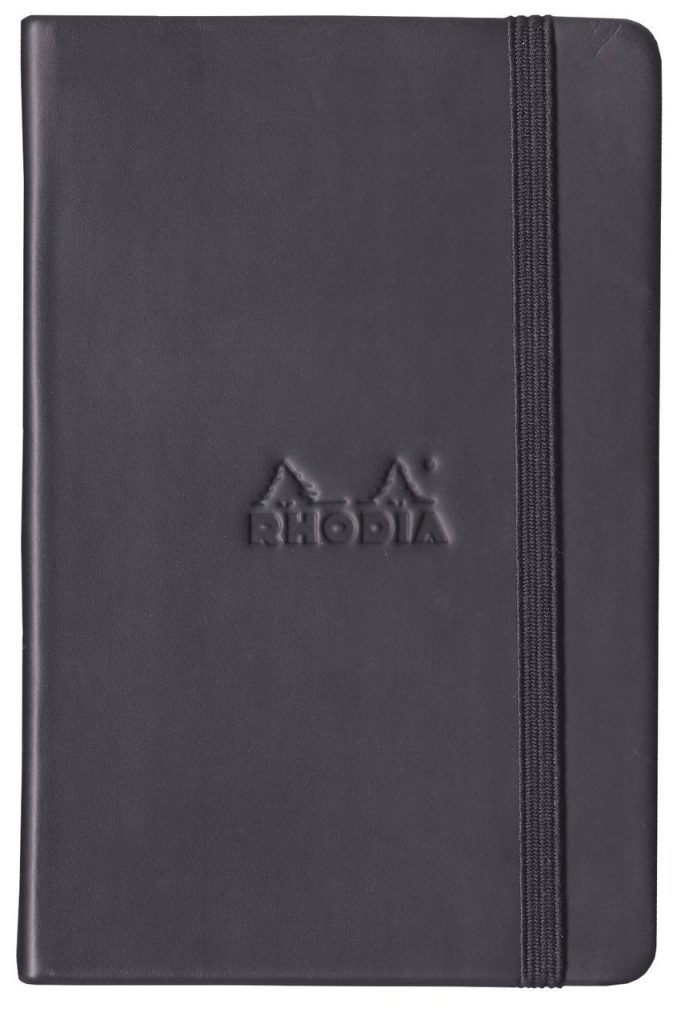
The Webnotebook uses a stiff cardboard hardcover in Rhodia’s signature orange or black colorways. The hardcover provides writing support when the notebook is used on soft surfaces — a lap, a couch, an airplane tray table — that would cause a softcover notebook to flex under writing pressure. The hardcover also provides superior physical protection for the pages, particularly relevant for notebooks carried in bags where they are subjected to compression from surrounding items.
Ruling Options
The Webnotebook A5 is available in dotted, lined, blank, and graph ruling formats, each serving different use cases. The dotted format is the most popular for creative and organizational use, providing the layout flexibility valued by bullet journalists and planner enthusiasts. The lined format is preferred by writers who prioritize text alignment. The blank format serves artists and visual thinkers who want an entirely unconstrained surface. The graph format is ideal for mathematical, technical, and diagrammatic work.
Who Uses the Webnotebook
The Rhodia Webnotebook attracts a specific type of notebook user: someone who uses quality writing instruments and wants a notebook whose paper can do justice to those instruments. Fountain pen collectors who spend significant money on inks and nibs often find that mediocre paper is the weakest link in their writing experience, and the Webnotebook eliminates that limitation definitively. For this audience, the premium price of the Webnotebook is easily justified by the improvement in daily writing experience.
Conclusion
The Rhodia Webnotebook A5 is the finest commercially available notebook for fountain pen users and anyone who wants the best possible paper for their writing instruments. Its 90 g/m² Clairefontaine paper, sewn binding, and flat-opening construction combine to create a writing experience that is genuinely superior to what any competing notebook provides. For those who take their writing tools seriously, the Rhodia Webnotebook is an investment that pays dividends with every page.
Final Thoughts and Long-Term Value
One of the reasons this product continues to remain popular among students, professionals, hobbyists, and collectors is the balance it offers between affordability, reliability, and everyday usefulness. Many products become successful for a short period because of trends, marketing campaigns, or social media attention, but truly excellent tools continue to be recommended for years because users trust them in practical situations. A dependable writing or office tool becomes part of a person’s daily routine, and over time that familiarity creates a stronger appreciation for the product’s design and consistency.
Another important factor is versatility. Whether the product is being used in schools, offices, creative studios, or at home, it adapts well to different environments and different working styles. People often underestimate how much productivity and comfort can improve when they use tools that are thoughtfully designed. Small details such as grip comfort, balanced weight, smooth performance, refillability, durability, and portability all contribute to a better overall experience. These qualities are especially valuable for people who spend many hours writing, organizing, drawing, planning, or studying.
In addition to functionality, the product also reflects broader trends in modern stationery culture. Over the past decade, interest in premium stationery and high-quality office supplies has increased dramatically around the world. Many consumers now see stationery not only as a practical necessity but also as a form of self-expression and creativity. This shift has encouraged manufacturers to improve aesthetics, expand color selections, refine materials, and introduce features that make everyday tasks more enjoyable. As a result, products like this continue to gain loyal communities of enthusiasts who share recommendations, reviews, and creative uses online.
Durability also plays a major role in long-term value. A product that lasts for years reduces waste and provides better value compared to disposable alternatives that need frequent replacement. Consumers are increasingly paying attention to sustainability, and reusable or refillable stationery products align well with those priorities. High-quality construction means the product can maintain strong performance over extended periods, making it a worthwhile investment for people who value dependable tools.
Ultimately, the enduring success of this product comes from its ability to combine thoughtful engineering, user comfort, visual appeal, and practical reliability into a single experience. It is easy to recommend because it consistently delivers what users expect while also offering small details that improve everyday tasks in meaningful ways. Whether someone is discovering the product for the first time or has been using it for years, it remains one of the strongest options available in its category and continues to set a high standard for competitors across the stationery industry.
